order by 5pm for same-day delivery within Klang Valley and Selangor!
Share this post:
A cake that looks perfect on the table can disappear in ten minutes if the size is off. If you are wondering what cake size for party planning, the right answer is less about guessing and more about how many people you are serving, how generously you plan to slice, and what else is being served alongside it.
For birthdays at home, office celebrations, kids’ parties, and family gatherings, choosing cake size well means everyone gets a satisfying slice and the host avoids that awkward moment when the final few guests are left with crumbs. A beautiful cake should feel abundant, festive, and easy to serve.
Most people start with guest count, and that is the right first step. But guest count alone does not tell the whole story. A party for 20 adults after a full dinner usually needs a different cake than a party for 20 children at 3 p.m. with snacks, ice cream, and cupcakes on the table.
The three factors that matter most are the number of guests, the size of each slice, and whether the cake is the main dessert. If the cake is the star of the celebration, plan a little more generously. If there are several desserts, you can size down slightly without anyone feeling shortchanged.
Height matters too. A taller cake can serve more people than a shorter one with the same diameter. That is why two 8-inch cakes are not always equal in servings. Layer count and fill level can quietly change the math.
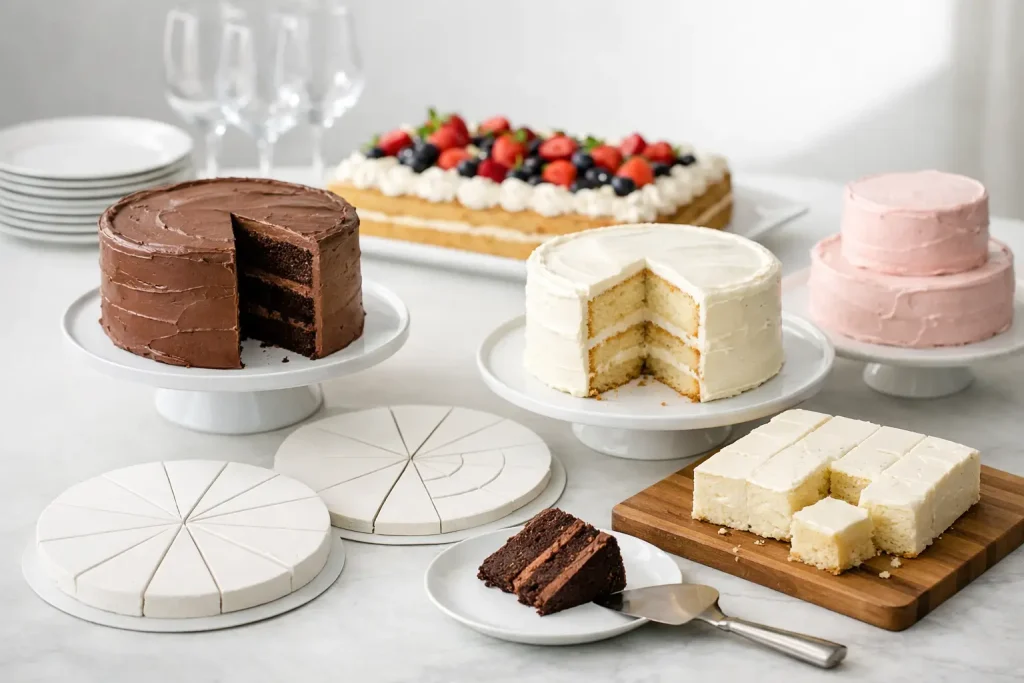
For round cakes, a practical party estimate is easier than complicated bakery charts. If you want normal party slices rather than tiny wedding-style portions, this is a reliable guide.
A 6-inch round cake usually serves about 8 to 10 people. A 7-inch round cake serves around 10 to 12. An 8-inch round cake works for about 12 to 16. A 9-inch round cake often serves 16 to 20. A 10-inch round cake generally serves 20 to 24.
For sheet cakes, servings go further because the cake is cut into rectangles. A quarter sheet usually serves about 20 to 24. A half sheet can serve roughly 35 to 50, depending on portion size. Full sheet cakes are better suited to large events and can serve 70 or more.
If you are ordering a tall layer cake, ask how many layers it has and how it is typically sliced. A premium celebration cake with four generous layers may serve more guests than expected, while a shorter cake with dramatic decoration may serve a little less.
For 8 to 10 guests, a 6-inch cake is usually enough if the group is small and the meal is light. For 10 to 15 guests, a 7-inch or 8-inch cake is the safer choice.
For 15 to 20 guests, an 8-inch or 9-inch cake works well. If your crowd loves dessert, go bigger. For 20 to 30 guests, a 10-inch round cake or a quarter sheet cake is often the sweet spot.
For 30 to 50 guests, a half sheet cake or multiple smaller cakes is usually more practical than one round cake. Multiple cakes also make serving easier and can let you offer more than one flavor.
The same guest count can lead to different cake choices depending on the event. That is where many hosts get tripped up.
A kids’ birthday party usually calls for larger servings than you might expect, not because every child eats a lot, but because parents often want enough for themselves too. Add cousins, siblings, and last-minute guests, and the cake goes quickly. If there are cupcakes, cookies, and goodie bags, you can stay closer to the lower end of the serving estimate.
An office party is different. Portions tend to be smaller, especially during working hours. A cake for 20 coworkers may not need the same size as a cake for 20 family members at a birthday dinner. People often take a modest slice, especially if the celebration includes other snacks.
For a dinner party, think about timing. After a heavy meal, guests may prefer slimmer slices, but they still expect enough cake for the moment to feel complete. If the cake has a rich flavor like chocolate fudge or cheesecake-inspired filling, smaller servings may be perfect. If it is a lighter sponge with fruit or cream, guests may happily eat more.
Birthday cakes tend to carry more emotional weight than everyday desserts. People gather around them, sing, take photos, and often expect a proper slice. For that reason, birthday parties are one place where ordering slightly more cake usually feels wise.
If the birthday cake is also the centerpiece, size up rather than down. A cake that looks too small on a decorated table can feel underwhelming, even before it is cut. A little extra gives you cleaner slices, less stress, and maybe a few leftovers for the next day, which is rarely a bad thing.
Family gatherings can be unpredictable in the best way. An aunt may bring extra guests, kids may ask for seconds, and someone always wants a slice packed to take home. If the occasion is meaningful – a parent’s birthday, Mother’s Day, an anniversary dinner, or a holiday celebration – adding a few servings of cushion is a thoughtful move.
One larger cake creates a classic centerpiece. It looks elegant, photographs beautifully, and keeps the celebration focused. This works especially well for birthdays, milestone dinners, and smaller gatherings where presentation matters.
Two smaller cakes can be the smarter choice for larger groups. You get more flexibility with flavors, easier slicing, and better portion control. It is also helpful if your guests have different preferences. One chocolate cake and one lighter option often pleases a crowd better than a single flavor.
This approach is especially useful for mixed-age parties or festive gatherings where some guests prefer something familiar and others enjoy more distinctive flavors like pandan, gula melaka, or onde-onde inspired cakes. It feels generous without being excessive.
The most common mistake is ordering based only on appearance. A cake may look lavish online, but decorative height, toppers, and frosting details do not always equal more servings.
The second mistake is forgetting the rest of the menu. If there is a dessert table with brownies, tarts, cookies, and fruit, you can often order a bit smaller. If the cake is the only sweet finish, give yourself more room.
The third mistake is not accounting for who is actually attending. Adults, teens, and children all eat differently, and some groups are simply more dessert-focused than others. If your family treats cake as the best part of the party, trust that instinct and order accordingly.
If you are between two sizes, the larger one is usually the safer bet for celebrations. Cake is one of the few party essentials that guests notice immediately, and running short feels far worse than having a few slices left over.
A good rule is to take your guest count and add a little buffer for generosity, uneven slicing, and surprise plus-ones. For intimate gatherings, that may mean planning for two extra servings. For bigger events, it may mean five or more.
It also helps to think about the feeling you want to create. A party cake is not just about math. It is part of the welcome, part of the photos, and part of the memory. When it arrives fresh, beautifully presented, and sized just right, the whole celebration feels more effortless.
At Sweet Passion, that is often what customers are really looking for – not just a cake, but the comfort of knowing the moment will be covered. The best cake size is the one that lets you celebrate freely, serve everyone with ease, and still have that lovely sense of abundance when the candles are lit.
If you are still deciding, choose the size that gives the room a little more joy than you think you need.

Same Day Cake Delivery On
Orders Before 5PM (Mon-Sat)

Choose Your Preferred
Delivery Slot

Finest Selection
Of Cakes

our cakes are
100% halal certified



Be the first to know about new flavors, exclusive offers, and more.